
What happens when a government department stops talking like a government department?
DOC’s campaign: Always Be Naturing
Last September, the Department of Conservation launched a campaign that looked, at first glance, like a fairly radical departure from the way government departments usually talk to the public.
It had a strange name. It invented a verb. It used humour. It was deliberately provocative in places. It talked about nature in a way that felt much more like popular culture than a government campaign.
Always Be Naturing.
I was fortunate to work with DOC in the months leading up to the launch, helping with the strategic messaging, narrative positioning and PR approach - the work that happens before most people ever see a campaign: getting clear on the story, the audiences, the messages, and how the idea could translate into something with relevance beyond the campaign itself.
A year on, I've been thinking about why the campaign felt so different, and what I think it gets right about public-sector communications. Because the interesting thing about Always Be Naturing isn't simply that it was creative - it's that the creativity was being used to solve a very specific communications problem.
The problem wasn't that people didn't care
One of the most useful things about the research underpinning the campaign was that it challenged an assumption that can easily creep into conservation communications: that the public needs convincing to care about nature.
The research suggested almost the opposite. DOC found that 97% of New Zealanders felt connected to nature and 98% cared about protecting and restoring it. At the same time, 89% thought nature was in good shape.
That's a much more interesting communications challenge than it first appears. If people don't care, you need to create care. If people already care but don't understand the scale of the problem or their own role in it, the task is different - you need to turn existing concern into understanding and, ultimately, action.
A lot of environmental communications end up competing on the wrong thing. We reach for bigger statistics, more alarming imagery and more urgent language because the issue itself is urgent. But telling people something is serious doesn't necessarily tell them what to do about it - and it can create distance. Conservation starts to feel like something that belongs to experts, scientists and committed environmentalists rather than something ordinary people participate in.
Always Be Naturing took aim at that distance.
The cleverness of "naturing"
The campaign's most interesting strategic move, in my view, was turning conservation into a verb.
Naturing is intentionally a slightly ridiculous word - that's part of its appeal. But beneath the humour is a useful reframing: you don't have to identify as a conservationist to take part in conservation, and you don't have to do anything particularly heroic.
You can put a bell on your cat. You can plant something. You can learn about the species in your backyard. You can spend time in nature on your lunch break. You can join a community conservation group, or simply support someone else doing the work.
The campaign creates a broad spectrum of participation rather than presenting conservation as a binary choice between doing nothing and becoming a highly committed environmental volunteer. It changes the question from “Are you a conservation person?” to “What does naturing look like for you?” - and once you've made that shift, there are many more ways to bring people into the conversation.
But the really interesting thing is that DOC didn't stop with individuals.
Getting business naturing
It would have been relatively straightforward to build a campaign aimed only at individuals: get outside, connect with nature, volunteer, donate, make changes at home. But businesses are where a huge amount of influence sits. They employ people. They shape consumer behaviour. They own and manage land. They influence supply chains. They have customers, communities and networks that a government agency cannot reach on its own.
Bringing businesses into the campaign wasn't just a matter of adding another audience to the media plan - it expanded the theory of change behind the communications. The question becomes less "How do we get more New Zealanders to care about conservation?" and more "How do we get the places where New Zealanders work, spend money and make decisions to become part of the conservation effort?" That's a much bigger proposition.
DOC created a specific business-facing strand of Always Be Naturing, encouraging organisations to get their people involved, support conservation, and consider the role they play in protecting nature - with practical ways to participate, rather than simply being asked to endorse the issue.
That distinction matters. If you tell a business that biodiversity matters, you've communicated an idea. If you give it a way to involve its staff, engage its customers, support a conservation project or change something about how it operates, you've created the possibility of behaviour change. That's a very different role for communications - and a very different role for a government agency.
The organisation doesn't have to own the story
Government communications often have an unavoidable structural problem: the organisation commissioning the campaign is also the organisation whose work needs explaining. That tends to produce communications that are fundamentally organisation-centred: here's what we're doing, here's why our work matters, here's how we're making a difference.
Always Be Naturing was much more interested in what happens beyond DOC. The business strand is a good example: DOC provides the organising idea and the credibility, but businesses take that idea somewhere DOC itself can't - interpreting it through their own people, customers, places and operations. The same is true of community groups, conservation organisations, whānau and individuals.
That's a more distributed model of communications. DOC isn't trying to be the only voice in the campaign; it's creating a platform other people can participate in. I think that matters increasingly for organisations trying to communicate about issues too large or complex for one organisation to solve alone.
There's a tendency in strategic communications to think about audiences as people we need to reach with a message. But some audiences are more useful than that - they can become participants, partners, messengers and amplifiers. Businesses are particularly powerful here because they sit at the intersection of so many audiences at once: an employee is also a parent, a consumer, a volunteer and a community member, all while being part of an organisation that can influence thousands of other people. Activating business isn't just adding a stakeholder group - it can multiply the reach and relevance of the central idea.
Why the jokes aren't the risk
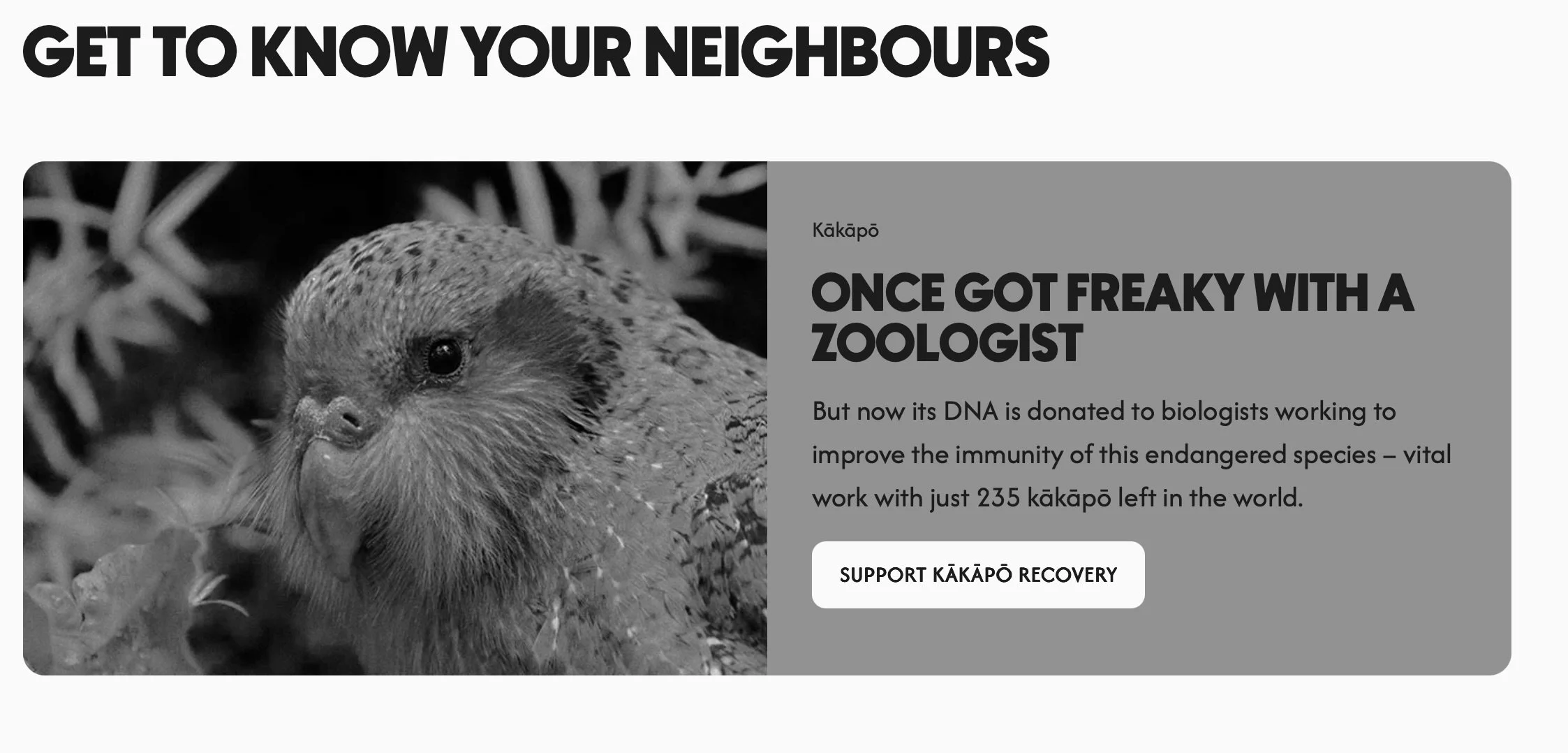
This is probably the bit people noticed first: Always Be Naturing is funny. Not universally hilarious - humour is subjective, and some of the lines are deliberately obvious enough that you can feel the wink behind them. But that's precisely what makes the approach interesting.
Government communications tend to be cautious for understandable reasons: multiple audiences, political sensitivities, reputational considerations, a legitimate fear of getting the tone wrong. The result can be communications that are perfectly safe and perfectly forgettable. Always Be Naturing was prepared to risk being a little awkward, a little silly — and, importantly, it trusted people to understand the joke. That's harder than it sounds.
When you're communicating about a serious issue like biodiversity loss, there's always a question of whether humour undermines the seriousness of the subject. I think the campaign largely avoids that problem because the humour isn't the message - it's the delivery mechanism. The underlying proposition stays serious: New Zealand's natural environment is under pressure, people care about it, and everyone has a role in protecting it. The humour just gives people a reason to stop and listen.
That's a useful distinction, because "be more entertaining" is a fairly useless lesson for communicators. The useful lesson is to use creativity to remove a barrier between your audience and the thing you need them to understand.
The risk of being different is also the point
One of the things I find most interesting about public-sector communications is the tension between wanting to stand out and wanting to avoid risk. You can't eliminate that tension, and you probably shouldn't - but you can decide where the risk is worth taking.
Always Be Naturing took its risk in the creative expression rather than the underlying message. The strategy itself was not complicated: connect people with nature, make conservation feel relevant and accessible, and create more opportunities for people and organisations to act. That clarity is what gave the creative work room to move.
People sometimes treat strategy and creativity as opposing forces - strategy constrains the idea, creativity makes the strategy interesting. In my experience it works the other way round. A clear strategy gives creative work permission to be distinctive. If you know what you need people to understand, what you want them to feel and what you want them to do, you have far more freedom to find an unexpected way of getting there.
A year on, the idea itself is what interests me most
Campaigns are usually judged by the launch: how many people saw it, what the media said, whether it was shared, whether people liked it. Those things matter, but I'm increasingly interested in what happens after the campaign moment; whether an idea has enough substance to keep being useful once the launch buzz is gone.
That's where I think Always Be Naturing has been most successful as a strategic platform. Naturing isn't just a campaign line; it's a piece of language DOC can apply to different behaviours, audiences and partnerships - playful or practical, as small as spending time outside or as significant as an organisation restructuring around conservation.
Rather than positioning nature as DOC's issue to communicate about, the campaign asks us to see it as something we all have a stake in. For a government department, that's quite a shift, and perhaps the broader lesson is this: the most effective public-sector communications rarely come from making government sound more like advertising. They come from understanding the audience well enough to know when the conventional way of communicating is getting in the way of what you're actually trying to achieve.
Sometimes the answer is a new campaign. Sometimes it's a new narrative. Occasionally, it's inventing a word that gives people - and the businesses and communities around them - a new way of seeing themselves in the story.
A year on, I'm still pretty pleased to have played a small part in helping get this one ready for the world.
